


Your next customer may never begin their software search on Google. Increasingly, B2B buyers open ChatGPT or another AI assistant, describe the problem they’re trying to solve, and ask for recommendations before they ever visit a search engine. By the time they click through to a website, they’ve often narrowed their shortlist to just a handful of vendors.
For SaaS founders, this creates a new visibility challenge. It’s no longer enough to rank well for commercial keywords if your competitors are consistently being recommended inside AI conversations while your business is absent.
Companies that appear repeatedly in those answers build awareness at the earliest stage of the buying journey, which is why AI visibility has become such an important part of modern SaaS growth.
This article explains what it actually takes to get your SaaS brand appearing in ChatGPT answers. Rather than chasing shortcuts or so-called AI hacks, we’ll look at the long-term foundations that help AI systems understand your company, trust your expertise and recommend your product when it genuinely matches a buyer’s needs.
- Why SaaS buyers are changing how they research software
- What does it mean to appear in ChatGPT answers?
- The six foundations of AI visibility
- Comparison: Traditional SEO vs AI Visibility
- Applying a GEO structure and seeing results – A case study
- What are some common mistakes in AI search optimisation?
- Ready to get found in AI search?
- Frequently asked questions
Why SaaS buyers are changing how they research software
The buying journey has become far more conversational than it was even a year ago. Instead of searching dozens of keywords, buyers ask complete questions, compare options, refine their requirements and continue the conversation until they’re confident enough to evaluate a small number of vendors.
That shift rewards companies with genuine authority, not those relying on isolated SEO tactics. AI assistants synthesise information from many trusted sources, meaning your reputation across the web now matters as much as what appears on your own website.
For founders, the opportunity is significant. Showing up during those early recommendation stages means your sales team begins conversations with prospects who already understand your value proposition rather than discovering your brand for the first time.
What does it mean to appear in ChatGPT answers?
Unlike Google, ChatGPT doesn’t have a fixed number-one ranking. AI models generate responses dynamically, meaning the brands recommended can vary depending on the user’s question, the context of the conversation and, where applicable, information retrieved from the live web. That means how consistently your brand appears across the questions your ideal customers ask.
This isn’t just theory. Research from SparkToro found less than a 1% chance of ChatGPT returning the exact same list of recommended brands when you repeat the same prompt multiple times. The same brands in the same order occur even less frequently, making traditional rank tracking far less meaningful than measuring how often your business is mentioned.
Think of AI visibility as building probability rather than chasing a fixed position. The clearer your category, the stronger your authority and the more consistently trusted sources discuss your business, the greater the chance your SaaS company becomes part of the answer when buyers ask relevant commercial questions.
This is why Generative Engine Optimisation (GEO) extends beyond traditional on-page SEO. It combines technical foundations, authoritative content, third-party validation and clear positioning into one long-term strategy that helps AI systems confidently understand your business and recommend it when it’s genuinely relevant.
Today, many AI visibility platforms have shifted away from tracking rankings entirely, instead measuring metrics such as brand mentions, citation share and AI Share of Voice across ChatGPT, Perplexity, Claude, Gemini and other AI assistants.

The six foundations of AI visibility
No single optimisation will suddenly get your SaaS company recommended by ChatGPT. AI platforms build confidence in brands by combining hundreds of signals from your website, trusted third-party sources and the way your business is consistently described across the web.
The good news is that most of these signals are already familiar to companies investing in strong SEO and content marketing. The difference is that AI search places greater emphasis on clarity, consistency and authority, making it even more important that every touchpoint reinforces the same message about who you are, what you do and who you help.
Rather than chasing the latest AI trend, focus on strengthening the six foundations below. Together, they create a business that is easier for AI systems to understand, easier for buyers to trust and far more likely to be recommended when someone asks for software in your category.
The six foundations are:
1. Own a category with clear positioning.
2. Create answer-first content.
3. Build authority beyond your website.
4. Keep product information current.
5. Structure content for easy extraction.
6. Measure the prompts that drive commercial intent.
None of these tactics works in isolation. AI systems look for consistent patterns, so every customer review, comparison page, case study, knowledge base article and product page contributes to the overall confidence AI has in describing your business.
When these signals reinforce one another, your company becomes easier for AI to understand and easier for buyers to discover.
Comparison: Traditional SEO vs AI Visibility
| Traditional SEO | AI Visibility (GEO) |
| Optimises for search rankings | Optimises for recommendations |
| Focus on keywords | Focus on entities and authority |
| Backlinks are critical | Trusted mentions and consensus matter |
| Measures rankings | Measures brand mentions and prompt coverage |
Applying a GEO structure and seeing results – A case study
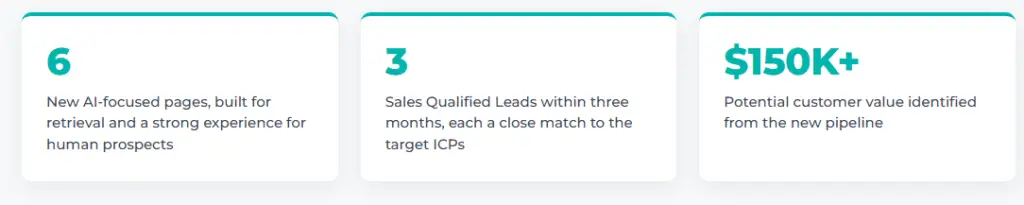
A SaaS company approached us because they were almost invisible on AI search platforms. They knew they were missing out on business, so we created six new pages, structured for AI retrievability but designed to be compelling for human users. The results are below. The business wins could be mapped directly through ChatGPT prompts and citations. The prompts used by the new customers mapped ditectly to the new pages and testing showed the citations backed that up.
Mike and his team at Whippet Digital have truly been an extension of our marketing team. They bring seasoned expertise in emerging tools and techniques, and apply it in ways that are immediately practical. The audits and reports they deliver are detailed, professional, and thorough, with clear analysis and recommended next steps we can act on right away. They operate as a true collaborative partner, and the results have exceeded our expectations. – Lisa Thiel Director of Marketing, FileInvite
What are some common mistakes in AI search optimisation?
In our AI Visibility audits we often see mistakes companies are making in their approach to optimisation for AI. These are some of the key issues.
Treating AI visibility as a separate channel instead of building on strong SEO fundamentals. Without a solid SEO foundation, no amount of AI-specific optimisation will compensate for the gaps.
Publishing generic content without demonstrating real expertise or customer experience. AI systems favour sources that say something no one else can.
Ignoring review platforms, industry publications and community discussions. Your own website cannot carry the story alone.
Never measuring which prompts actually influence the pipeline. Without tracking, you have no way of knowing what is working or where to focus next.
Ready to get found in AI search?
If your SaaS company wants to increase its visibility in ChatGPT and other AI platforms, focus on becoming the most trustworthy and clearly understood brand in your category.
At Whippet Digital, we help SaaS companies turn visibility into pipeline by combining SEO, AI visibility strategy and commercially focused content.
Get clarity on where you stand. Book a session with Mike Morgan, Co-founder of Whippet Digital and creator of the SaaS Growth Framework.
